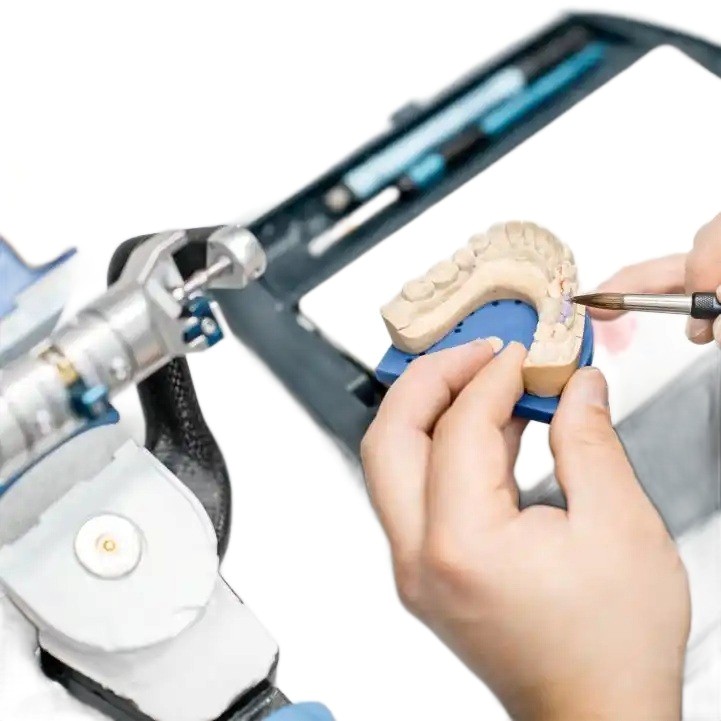
The dental laboratory industry is undergoing a massive evolutionary leap. For decades, the life of a lab technician revolved around the rhythmic sound of micromotors, the glow of Bunsen burners, and the delicate artistry of hand-stacking porcelain. Today, those classic sounds are increasingly accompanied by the hum of 5-axis milling machines and the click of a mouse.
On a business level, these advancements have brought incredible efficiency, but they have also triggered anxiety. Lab technicians and boutique owners are facing two massive market shifts: corporate consolidation and a widening labor gap.
If you are running an independent lab, you might be asking yourself: How do I prove my value when commercial mega-labs are swallowing up local shops? and How do I find young technicians who can appreciate classical hand-instrument artistry while remaining fluent in digital CAD/CAM workflows?
Let’s break down how your laboratory can navigate these structural shifts, design a smart hybrid layout, and leverage modern e-commerce strategies to remain highly competitive.
The Dual Threat: Consolidation and the Labor Gap
Corporate consolidation is reshaping the dental landscape. Large, commercial mega-labs are aggressively acquiring smaller, local boutique labs. This consolidation forces independent technicians to completely rethink their market value. Mega-labs win on volume and raw pricing power, but they often lose on the personalized, nuanced communication that complex, multi-unit cases require.
Simultaneously, the industry is grappling with a severe labor shortage. The ideal modern technician is a bit of a unicorn: they need to understand the physical physics of dental anatomy (the manual artistry) while mastering digital design protocols. Fabricating premium dental prostheses requires a delicate balance of manual casting and digital CAD/CAM workflows. Without an understanding of analog foundations, a digital designer is just guessing on screen; without digital speed, a master analog technician cannot scale.
To see how these market forces stack up, let’s look at the operational dynamics:
Laboratory Industry Consolidation
| Business Metric | Local Boutique Labs | Corporate Mega-Labs |
| Market Value Proposition | Highly customized, clinician-aligned, premium artistry | High-volume, standardized processing, aggressive pricing |
| Labor Dynamics | Deep reliance on master technicians; vulnerable to turnover | Standardized, assembly-line tasks; reliant on heavy automation |
| Equipment Strategy | Hybrid setups balancing hand-finishing with nimble digital tools | Mass-scale production lines, centralized milling centers |
| Sourcing Strategy | Direct e-commerce procurement for flexibility and low overhead | High-volume corporate contracts and rigid distributor agreements |
Balancing Digital Efficiency with Manual Artistry
The secret to surviving the consolidation wave isn’t choosing between manual or digital—it is mastering the hybrid workflow. Setting up a manual dental laboratory focusing initially on flexible partial dentures and conventional complete dentures is an excellent, cost-effective way to launch or maintain low overhead. By leveraging traditional hand manipulation techniques, you can bypass expensive CAD/CAM machinery early on while delivering high-demand prosthetics.
However, as you scale, integrating digital tools becomes mandatory to ease the burden of the labor shortage. The table below maps out how traditional manual steps seamlessly transition into advanced digital alternatives:
Digital Workflow vs. Manual Hand Artistry
| Workflow Step | Traditional Manual Options | Advanced Digital Options |
| Foundation / Capture | Manual impression pouring, vibrators, and model trimmers | Digital Intraoral Scanning or Benchtop Optical Scanners |
| Design Phase | Hand-waxing instrumentation, articulators, and surveyors | CAD design software platforms |
| Material Processing | Burnout ovens, induction/centrifugal casting units | 5-Axis Milling Units or 8K/14K 3D Printers |
| Sintering & Post-Process | Porcelain furnaces and manual finishing lathes | Specialized high-temperature Zirconia Sintering Furnaces |
Optimizing Your Lab Layout and Equipment Selection
When combatting labor shortages, your laboratory layout design is your silent business partner. An inefficient layout wastes steps, frustrates technicians, and slows down turnaround times. Your lab layout should separate the “dirty/wet” analog processes from the “clean/dry” digital infrastructure.
1. The Analog/Wet Zone
For labs processing traditional Porcelains Fused to Metal (PFM), removable partial denture frames, or gold alloy restorations, your layout requires dedicated thermal and mechanical containment.
Casting & Melting Room: Needs heavy-duty manual centrifugal casting machines or electronic induction casting units.
Thermal Processing Area: Space for programmable burnout ovens for wax elimination and PFM porcelain furnaces.
Model Bench Prep: Equipped with vibrators, model trimmers, and manual dental surveyors to analyze undercuts and pour bubble-free stone models.
2. The Clean/Digital Zone
This area must be kept free of stone dust and metal filings to protect sensitive optical components.
Milling and Printing Station: Houses your 5-axis dental milling machines (capable of processing 98mm discs, titanium premilled abutments, or lithium disilicate blanks) and high-definition dental 3D printers.
When scaling your physical space, sourcing equipment efficiently becomes a make-or-break business decision. Dentsma provides a comprehensive range of equipment that supports both traditional manual casting workflows and advanced, fully digital CAD/CAM processing series. By configuring your production layout across these clear operational tiers, you allow your master technicians to focus on critical hand-finishing, while letting automation handle the heavy lifting.
The Strategy: A Unique Advantage for Independent Labs
To compete with mega-labs that negotiate massive corporate discounts, independent labs must rethink how they buy hardware and consumables. Traditional dental distribution channels are loaded with middleman markups and slow sales cycles. Embracing direct dental e-commerce platforms is your secret weapon for maintaining agility and protecting profit margins.
As an online supplier and distributor of professional dental and laboratory equipment, Dentsma operates an e-commerce platform that distributes dental products directly to dental practices and prosthodontic laboratories. This modern procurement model offers unique business advantages:
On-Demand Scaling: Rather than trapping your business in restrictive, long-term leasing contracts with traditional corporate distributors, e-commerce platforms let you buy digital consumables—like PEEK, zirconia pucks, dental CAD/CAM wax blocks, and PMMA discs—on an as-needed basis.
Transparent Equipment Mapping: You can easily compare high-definition dental model printers (such as 14K resolution systems with 10.1-inch build areas) against standard dental 3D printers specialized for complex prosthetics or smooth gingiva masks without dealing with aggressive sales representatives.
Lower Overhead Costs: Direct-to-laboratory shipping minimizes markup costs, passing the savings directly back into your operational budget. This saved capital can be reinvested into hiring top-tier talent or cross-training younger staff.
Final Thoughts for the Forward-Thinking Technician
Corporate consolidation and labor gaps are undeniably challenging, but they also highlight the irreplaceable value of a skilled dental technician. Mega-labs can print and mill thousands of units a day, but they cannot replicate the deep clinical partnerships, the artistic eye for complex morphology, and the custom characterization that a boutique, hybrid lab provides.
By optimizing your lab layout, blending manual artistry with digital efficiency, and utilizing direct e-commerce platforms to manage equipment costs, you can position your lab as an indispensable, highly agile partner to clinicians. The future of dental technology belongs to those who can bridge the gap between the hand instrument and the digital screen.